 Zhi Sang
The class and my notes
I use the April 2, 2026 divide-and-conquer class from Algorithm Design and Analysis to explain how I combine classroom transcripts with slides. I organized the chapter notes on May 7, 2026, with 27 illustrations.
1. Read a classroom explanation
In transcript segment [6], the teacher discusses reducing four half-size multiplications to three by reusing AC and BD. This helped me identify the key idea in the classroom explanation: previously computed products can be reused.
The original recurrence is T(n) = 4T(n/2) + O(n), still quadratic. Karatsuba reduces the number of recursive multiplications from four to three; AC and BD are reused rather than counted as new subproblems.
2. Map the explanation to slides
| ASR segments | Slides | Topic |
|---|---|---|
| [4]–[5] | Ch5 P2–P5 | Divide-and-conquer framework |
| [5]–[10] | Ch5 P6–P11 | Karatsuba multiplication |
| [12]–[14] | Ch5 P12–P17 | Strassen matrix multiplication |
This is an excerpt from the existing overview. Page references make it possible to compare an explanation with the corresponding teaching material.
3. Organize the notes
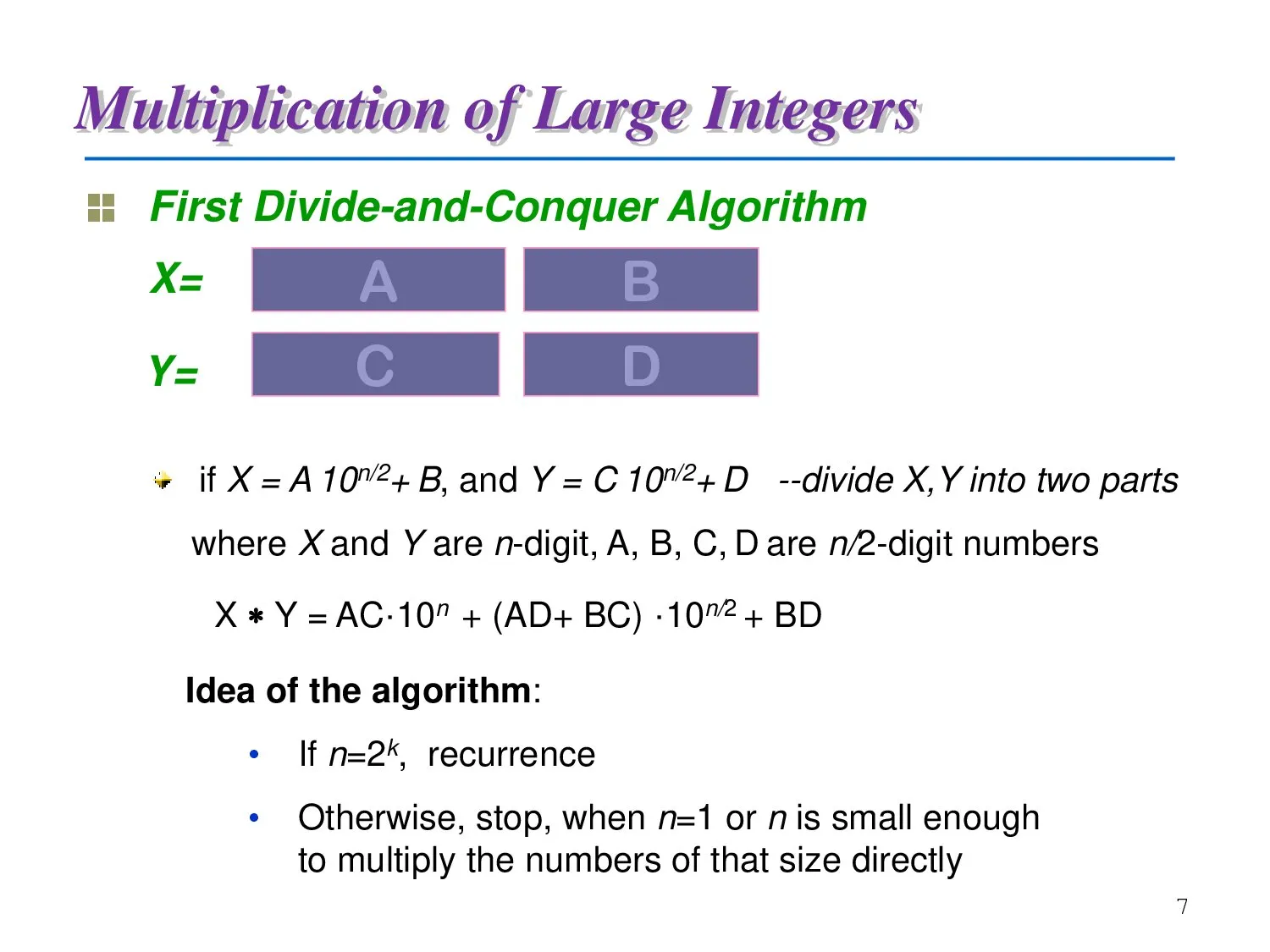
The existing notes explain the split, expand the multiplication, identify reuse and derive the recurrence. With X = A·10^(n/2)+B and Y = C·10^(n/2)+D, the cross term is:
This leaves three recursive multiplications:
My chapter notes also discuss number representation, carries and unequal lengths, connecting the formula to implementation details.
From classroom explanations to my own notes
I keep the transcript, slide references and notes connected throughout the process. The AI follows my conventions to use the tools, interpret explanations and organize the content. I keep refining it through reading, questions and use. When revisiting a topic, I can find the corresponding classroom explanation and slide.